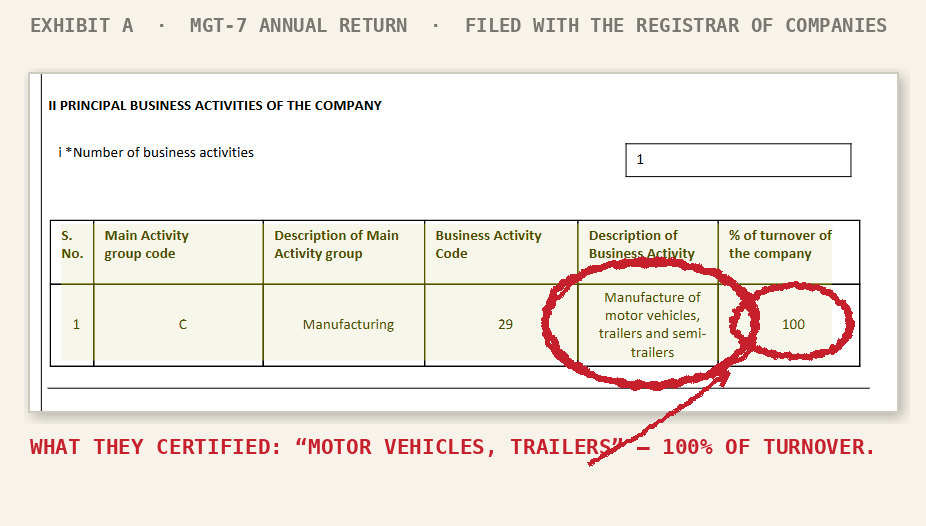
It declared trailers. It builds steel buildings.
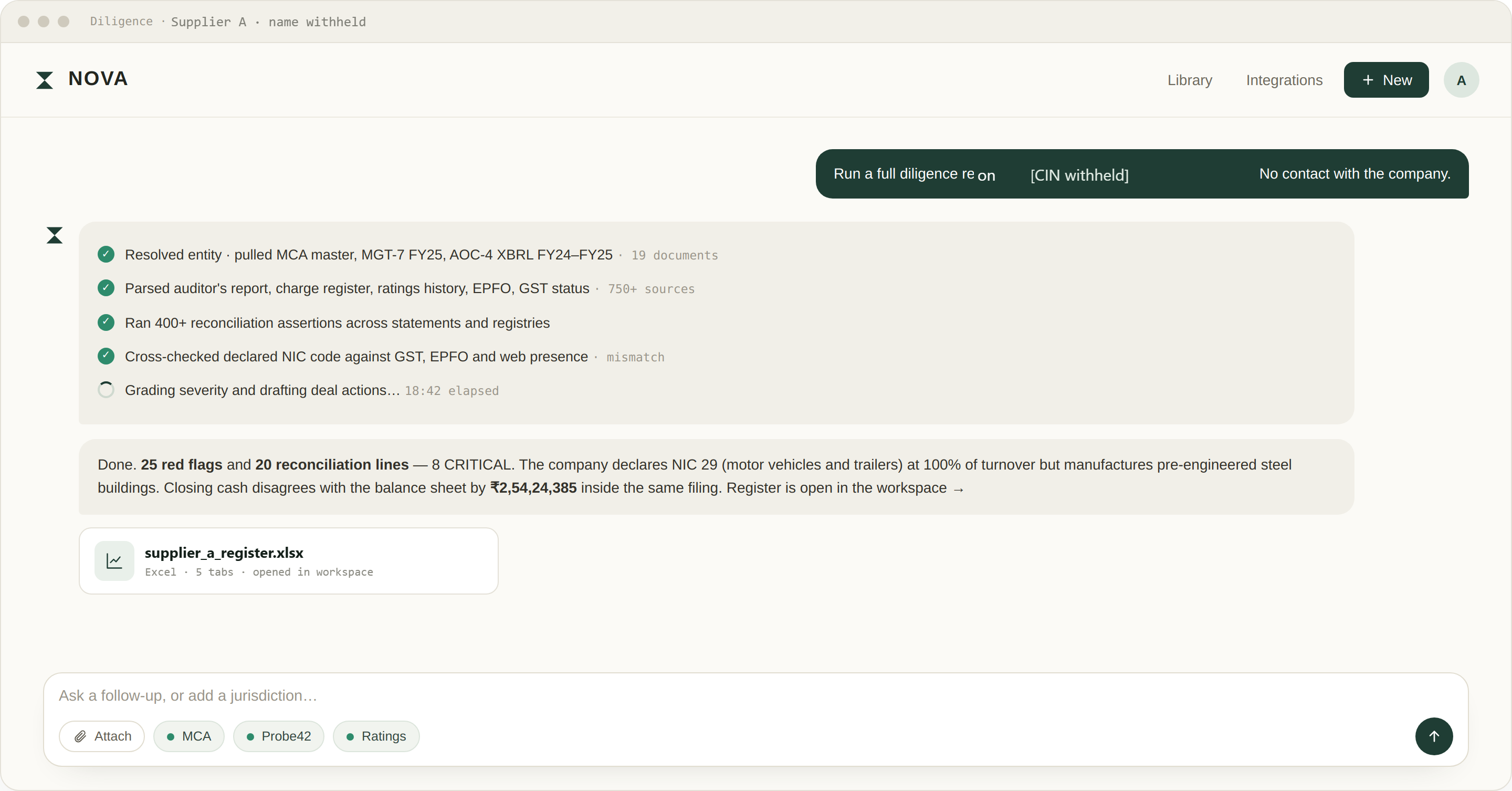
A US manufacturer was two containers into a new Indian supplier and about to award it a five-year program. We read what that supplier had filed with its own government and found twenty-five places where its own paperwork disagrees with itself.
SOURCE MATERIAL: 19 PUBLIC FILINGS · CONTACT WITH THE SUPPLIER: NONE · SUPPLIER NAME WITHHELD
The situation
The buyer sources fabricated steel structures and trailer assemblies out of India. Their sourcing team had found this supplier the way good sourcing teams do: pulled import records, saw containers already arriving at Newark, placed a trial order, got acceptable parts back.
The next step was a multi-year program with tooling. Before signing, they sent us one line of information — the supplier's name as printed on the bill of lading — and asked whether the business was sound.
They had already cleared the usual checks. The company was registered and traceable. A statutory auditor had signed its accounts. It held an investment-grade rating from an Indian agency. Its supplier questionnaire came back complete.
What the register said
Every Indian company files an annual return stating what it does, as a share of turnover. This one declared a single activity — manufacture of motor vehicles, trailers and semi-trailers — at 100%. That is a certified statement to the registrar, and it is the description a buyer's database inherits.
What the business actually is
Its own website sells pre-engineered buildings, cranes, storage racks and heavy metal fabrication. Nine navigation items, not one of them a vehicle. The shipping records agree with the website rather than the register: what left the gate was fabricated steel structures, under a different tariff heading from the one a trailer manufacturer would use.
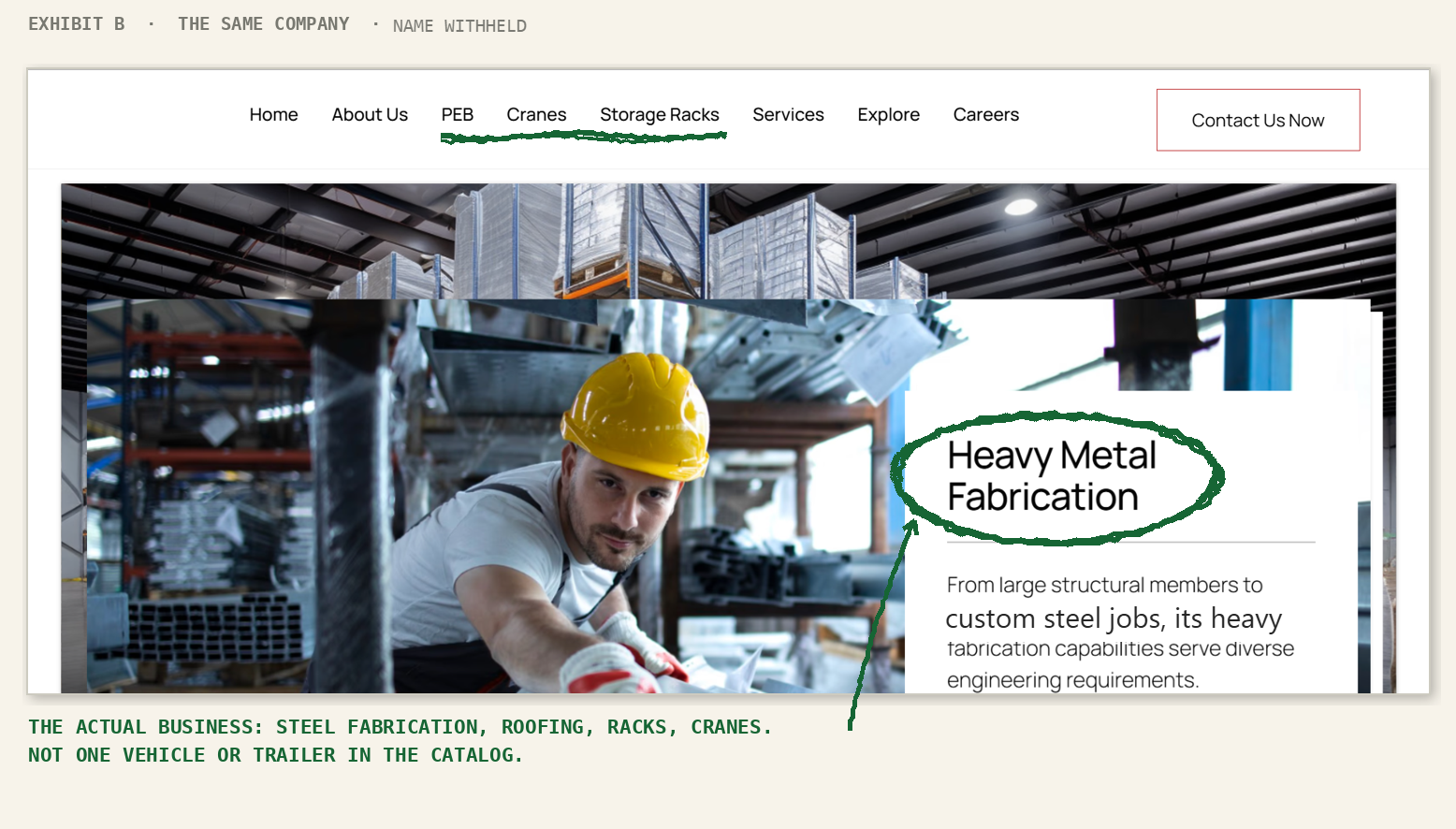
On its own account, then, the company is in a different industry from the one it certified. That one mismatch invalidates the buyer's sector benchmarks, its peer comparison, its capability assumptions and the tariff codes its compliance team had already filed against.
What we did
Four steps, no contact with the supplier at any point.
- {{ s.h }} {{ s.p }}
The extraction is done by language models; the verdicts are not. Each of the 400-plus checks is an equation on two figures the company reported itself — closing cash equals closing cash, a subsidiary's related-party sales stay plausible against its own asset base. It passes or it fails, and either way it carries the document and the page.
The clearest contradiction
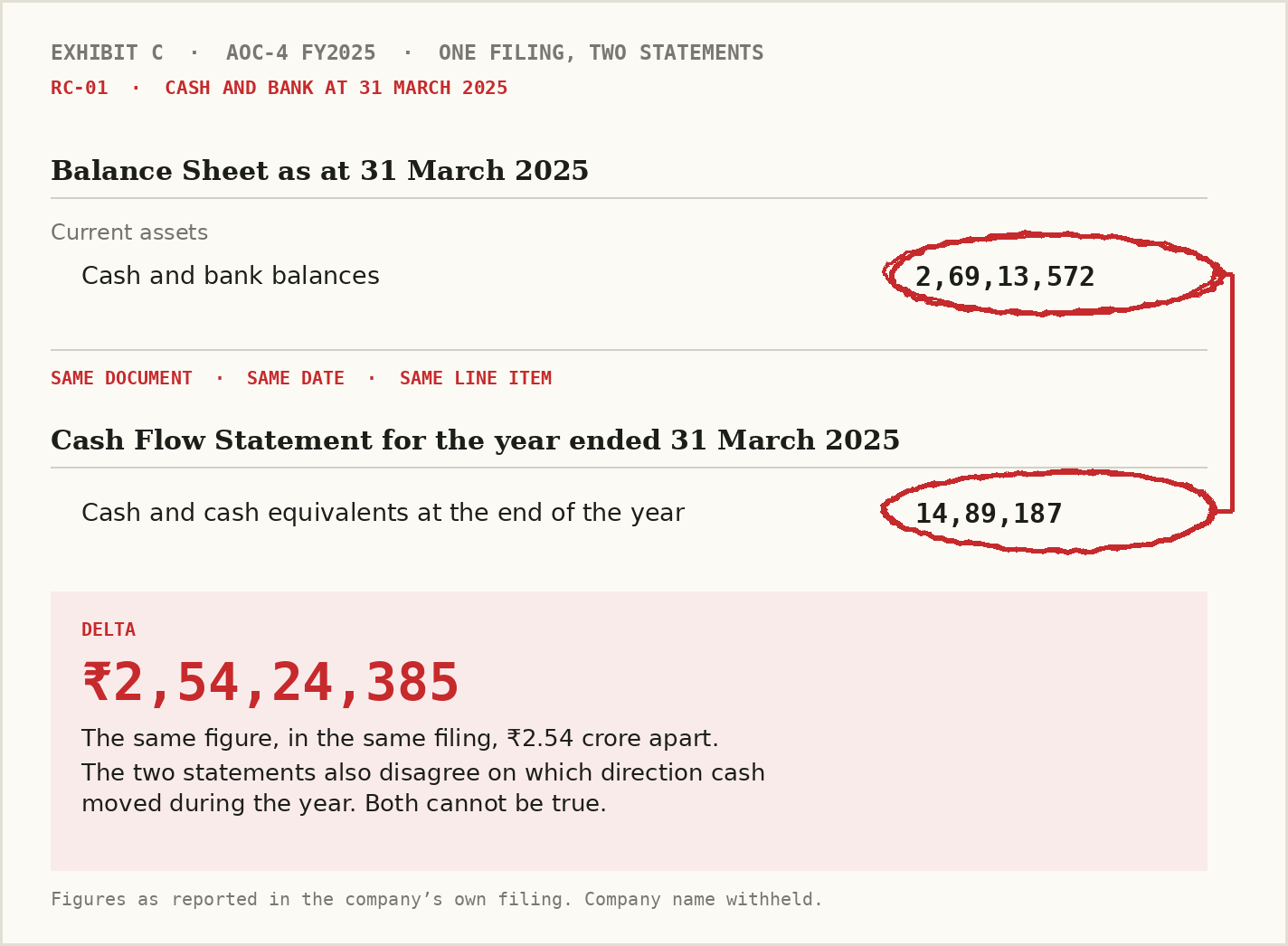
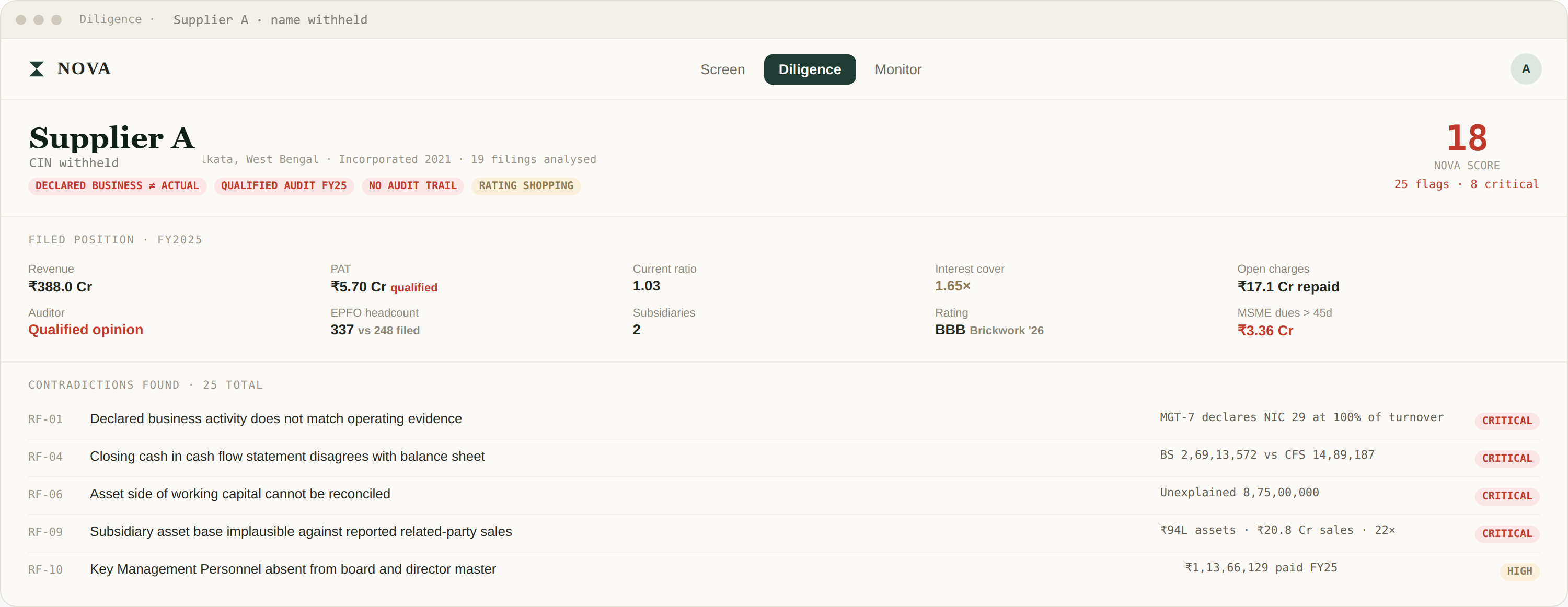
How much cash did the company hold at year end? Its balance sheet says ₹2,69,13,572. Its cash flow statement — same filing, same date, same line item — says ₹14,89,187. The gap is ₹2.54 crore, about $290,000, and the two statements also disagree on whether cash rose or fell that year.
Sitting above those accounts is a qualified auditor's report, which notes that profit is overstated by an amount that, in the auditor's own words, cannot be fairly quantified. That sentence was already public. It had never reached the buyer.
Twenty-five findings, six that mattered
Eight of the twenty-five were graded critical. These are the ones that changed the decision.
{{ f.h }}
{{ f.p }}
What the existing checks had said
Four checks had already passed this supplier. None of them was wrong; none of them asks whether a company's filings agree with each other.
What the buyer did
They did not drop the supplier. Parts were arriving and they were acceptable. What changed was the exposure: the five-year program and its tooling went to a second source, this supplier stayed at trial volume with payment on delivery rather than in advance, and no part was left single-sourced to them.
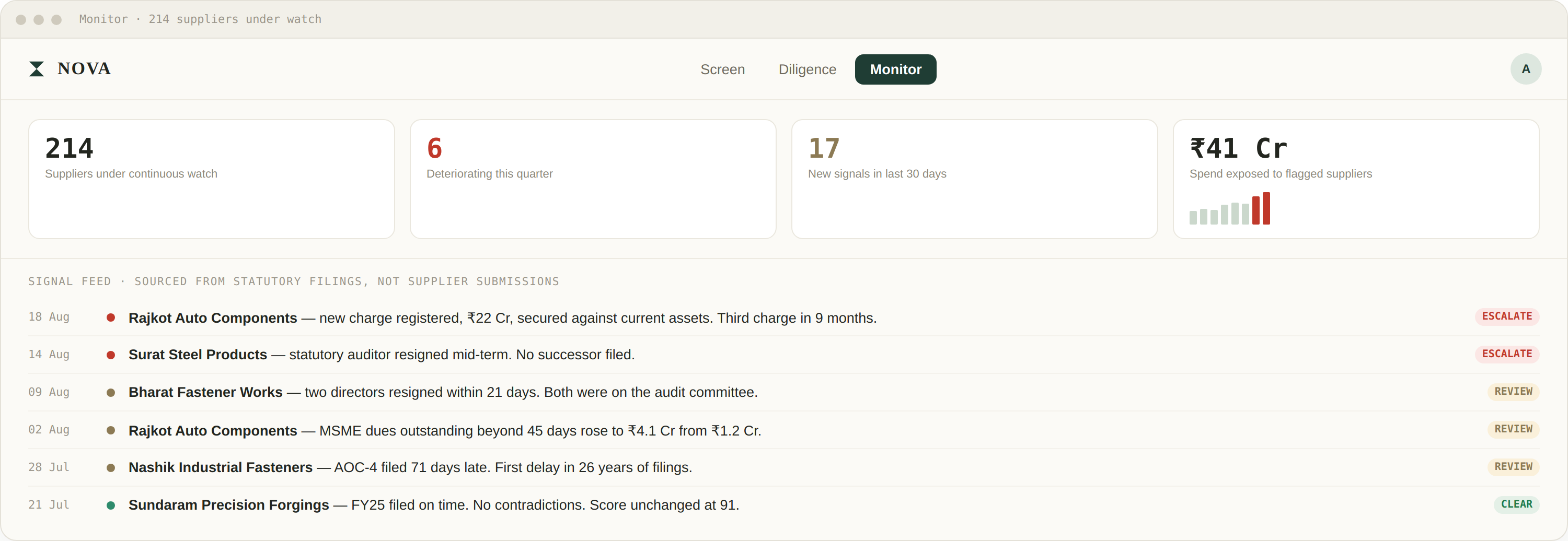
The company was then added to continuous monitoring alongside their other Indian plants, so the next charge registered, auditor exit or late filing arrives as an alert rather than at the annual review.
Notes
The supplier's name, identifier and logo are withheld and its website screenshot is redacted. Every figure quoted is reproduced, unaltered, from documents the company filed with Indian authorities or published itself. A contradiction is a statement about those documents — that two of them do not agree — and not an allegation of wrongdoing. The buyer is described in general terms at their request.
Method in one line: resolve the entity, pull everything it has filed, run fixed reconciliation checks across those documents, and report each failure with both figures and the source page.
We run the same check on one supplier at no charge, on request. Name a supplier you already buy from and we'll send back what we find, with the pages. We do not contact the supplier.
Check one supplier freePrefer email? Write to team@nova-labs.in.
← NOVA LABS · © 2026